What Is My ISP? |
Probably a VPN or proxy. Amazon.com, Inc. is a datacenter or VPN network, so you're seeing your VPN's provider, not your home ISP. Turn the VPN off and reload to see your own provider.
216.73.216.95
AS16509
Test your speed → Is my IP blacklisted? → Full details for your IP →
Your ISP (internet service provider) is the company that connects you to the internet, such as Xfinity, Spectrum or BT. We detect it from your public IP address, IPv4 or IPv6, which belongs to your provider's network.
How Do I Find Out Who My Internet Provider Is?
Open this page: it shows your provider's name from your IP address. You can also check your router's admin page or your bill.
- Your bill or contract: the brand you pay is your ISP.
- Your router: the label usually shows the provider; its admin page (often 192.168.1.1) names it on the WAN or Internet page.
- A traceroute: run
tracert 8.8.8.8(Windows) ortraceroute 8.8.8.8(macOS, Linux). The hops after your router often carry the provider's domain name.
To find the provider of someone else's IP address, use the IP lookup. For the providers available at an address, use your country's broadband map (the FCC National Broadband Map in the US, Ofcom's checker in the UK): this page shows only the one you're using now.
What Is an ISP?
ISP stands for internet service provider: the company that connects your home or phone to the internet, such as Xfinity, Spectrum, AT&T, Verizon or BT. Every device you use online reaches the internet through one.
What your ISP does for your connection:
- Connects you by fiber, cable, a phone line, radio or satellite (table below).
- Gives you a public IP address, usually a dynamic one that can change (static vs dynamic IP). Some providers share one address between many customers (CGNAT).
- Answers your DNS lookups by default, unless you choose another DNS server.
- Carries your traffic to the rest of the internet through its own network, which has a number of its own (the ASN, explained below).
| Connection | How it reaches you | Examples |
|---|---|---|
| Fiber | Optical fiber to the home: the fastest, same speed up and down on most plans | AT&T Fiber, Verizon Fios, Google Fiber |
| Cable | The TV coaxial cable | Xfinity, Spectrum, Cox, Virgin Media |
| DSL | The copper telephone line: slower, being replaced by fiber | Local telephone companies |
| 5G home internet | A mobile network, received by a box at home | T-Mobile Home Internet, Verizon 5G Home Internet |
| Mobile data | Your phone's carrier network | Verizon, AT&T, T-Mobile, EE, Vodafone |
| Satellite | A dish pointed at satellites: for areas without cable or fiber | Starlink, Viasat, HughesNet |
Your ISP is also the company that sees which sites you connect to (see the FAQ below), and the one to call when the connection is slow: run a speed test first, so you can tell them what you actually get.
Why Does the Provider Name Look Different From My Bill?
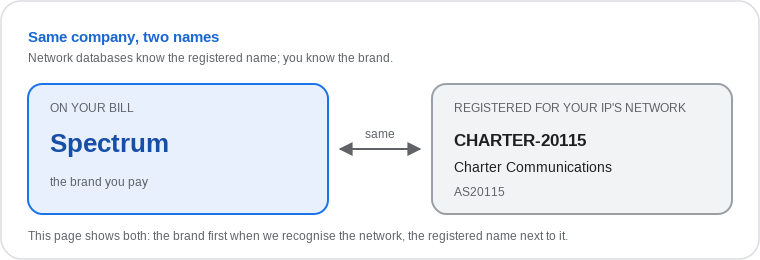
Networks are registered under company names, not brands: Spectrum's network is "Charter Communications", Xfinity's is "Comcast Cable".
| Brand on your bill | Registered network name | ASN |
|---|---|---|
| Xfinity | COMCAST-7922 (Comcast Cable) | AS7922 |
| Spectrum | CHARTER-20115 (Charter Communications) | AS20115 |
| AT&T Internet | ATT-INTERNET4 (AT&T Services) | AS7018 |
| Verizon Fios | UUNET (Verizon Business) | AS701 |
| Optimum | CABLEVISION (Altice USA) | AS6128 |
| BT Broadband | British Telecommunications PLC | AS2856 |
| Jio | Reliance Jio Infocomm Limited | AS55836 |
We recognise about 60 consumer providers in the US, UK, Canada, Australia, India, Germany and France and show their brand first. For any other network you see the registered name, which is still the right company.
Why Does It Show a VPN or a Different Company?
With a VPN, proxy or company network, websites see that network's IP, so its provider appears instead of your home ISP.
We flag networks on our list of datacenter and VPN providers, and IPs on the Tor Project's exit list. It's a strong hint, not proof: some VPNs use home addresses, and a few providers run both. On mobile data you see your carrier. Many providers share one public IP between customers (carrier-grade NAT); the IP still belongs to them, so the provider shown is right. Want to check your VPN? Use the proxy and VPN checker.
What Is an ASN and Why Does My ISP Have One?
An ASN is the number of your provider's network on the internet; big ISPs have one or more.
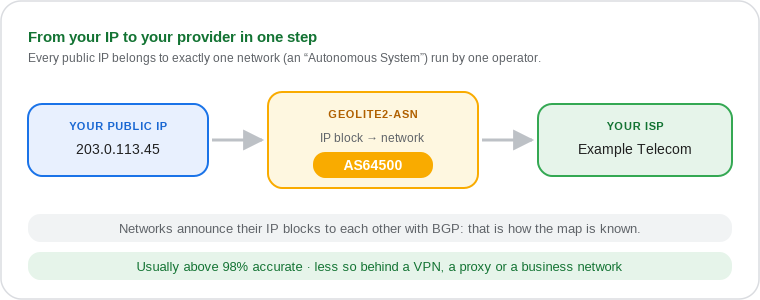
An autonomous system is a network that sets its own routing on the internet, and its number (ASN) is how other networks reach it through BGP. Regional registries assign the numbers and keep a public record of the company behind each one. Large providers often run several: Comcast has a network per region, and AT&T has separate ones for home and mobile. See any network's details in the ASN lookup.
How This ISP Check Works
| Your IP | The address your connection reaches us from, passed on by Cloudflare. Nothing to type. |
|---|---|
| Network and ASN | MaxMind GeoLite2-ASN, on our server. This product includes GeoLite2 data created by MaxMind, available from maxmind.com. |
| Brand | Our table of about 60 consumer providers, from the ASN registry records and the providers' own sites; reviewed 10 November 2026. No match: the registered name. |
| VPN and Tor | Our list of datacenter and VPN networks (by ASN), and the Tor Project's exit list, refreshed hourly. |
| Location | MaxMind GeoLite2 City: reliable for the country, much less for the city. |
| Last verified |
Frequently Asked Questions
Who is my internet provider?
What does ISP stand for?
How can I find my ISP without a website?
Why does my ISP show a different name?
Can my ISP see what websites I visit?
Does this page show ISPs available at my address?
Why does my phone show a different ISP than my laptop?
Next steps