You don't have javascript enabled. Please enable javascript to use this website.

IP Address Validator

Validate IPv4 and IPv6 addresses for syntax, version, and address class — single address or bulk list with Copy Valid filter.
IP Address:
Validate IP Clear
More Tools

What Is an IP Address Validator?

IP address validator checks any IPv4 or IPv6 address for correct format, protocol version, and address class. For IPv4, validation confirms the dotted-decimal notation contains exactly four octets each within the 0–255 range. For IPv6, it accepts full 128-bit notation, :: compressed notation, and link-local addresses with zone identifiers. Results classify each address as loopback, private (RFC 1918), link-local (RFC 3927), or public — with no data transmitted to any server.


IP Address Validator — Validate Any IPv4 or IPv6 Address for Syntax, Version, and Address Class

Enter any IPv4 or IPv6 address to verify its format and classify it as loopback, private (RFC 1918), link-local, or public — single address or bulk list.

1

Choose a Validation Mode

Select Single IP to validate one address, or Bulk List to validate multiple addresses at once — one address per line.
2

Enter an IP Address

Enter any IPv4 address in dotted-decimal notation (e.g. 192.168.1.1) or any IPv6 address including compressed notation (e.g. 2001:db8::1 or fe80::1).
3

Click Validate IP

Click the Validate IP button. The tool checks format and octet ranges for IPv4 or hexadecimal group structure for IPv6, then classifies the address type.
4

Read the Result

Read Status (Valid or Invalid), Version (IPv4 or IPv6), and Category (Loopback, Private, Link-Local, or Public). In Bulk mode, click Copy Valid to copy only well-formed addresses.

IP Address Category Reference

Each validated address is classified against the registered special-use ranges defined by IANA and the IETF. The tables below show every category the validator returns, with the governing RFC and exact address range.
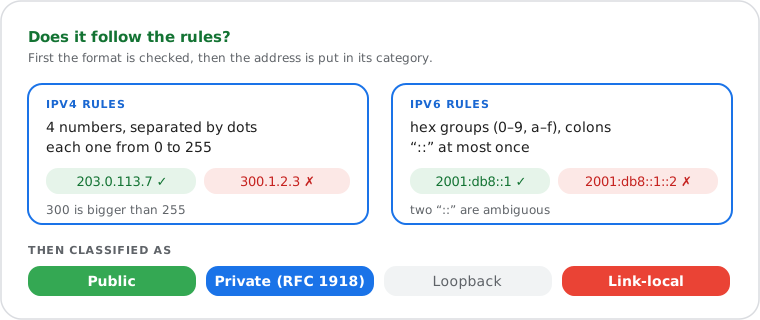
Diagram: IPv4 and IPv6 format rules with valid and invalid examples, then the categories public, private, loopback and link-local
First the format is checked, then a valid address gets its category.

IPv4 Categories

Category RFC Address Range Purpose
Loopback RFC 5735 127.0.0.1 Device communicates with itself
Private (RFC 1918) RFC 1918 10.0.0.0/8, 172.16.0.0/12, 192.168.0.0/16 Not routable on the public internet
Link-Local / APIPA RFC 3927 169.254.0.0/16 Auto-assigned when DHCP fails
Public / Global IANA All other valid addresses Globally routable on the internet

IPv6 Categories

Category RFC Prefix Purpose
Loopback RFC 4291 ::1/128 Equivalent to IPv4 127.0.0.1
Link-Local RFC 4291 fe80::/10 Network-segment scoped — not routed between segments
Unique Local (Private) RFC 4193 fc00::/7 (fc:: and fd::) IPv6 equivalent of RFC 1918 private ranges
Global Unicast (Public) RFC 4291 2000::/3 Globally routable — the IPv6 equivalent of a public IP

Common Uses for IP Address Validation

Firewall and access-control list auditing. Before committing an IP address to a deny or allow rule, validation confirms the address is correctly formed. A single malformed octet — 192.168.1.256 instead of 192.168.1.255 — will either be silently rejected or behave unexpectedly depending on the firewall implementation. Validating first prevents silent misconfigurations.

Server log and database cleaning. Applications that accept user-submitted IP addresses from forms, headers, or API payloads often accumulate malformed strings. Pasting a column of addresses into Bulk mode identifies the invalid entries in seconds — and the Copy Valid button produces a clean list ready for re-import without manual inspection.

API response and form input verification. A developer building a REST endpoint that accepts an IP address parameter needs to confirm whether the input passes the format rules before passing it downstream to a database query or network lookup. The category output confirms whether the submitted address is public (appropriate for external API calls) or private (a misconfigured client or internal testing address).


Frequently Asked Questions

What makes an IPv4 address invalid?
An IPv4 address is invalid if it contains anything other than exactly four decimal octets separated by dots, where each octet must be a number between 0 and 255 with no leading zeros. Common failures include out-of-range octets (e.g. 256.1.2.3), missing octets (e.g. 192.168.1), extra octets (e.g. 1.2.3.4.5), non-numeric characters, or CIDR notation (e.g. 192.168.1.0/24 — this validator accepts bare IPs only).
What does the Category field mean in the results?
Category classifies the address type based on its registered range. For IPv4: Private (RFC 1918 ranges 10/8, 172.16/12, 192.168/16 — not routable on the public internet), Loopback (127.0.0.1 — the localhost address), Link-Local APIPA (169.254.0.0/16, RFC 3927 — auto-assigned when DHCP fails), or Public/Global (everything else). For IPv6: Loopback (::1), Link-Local (fe80::/10, RFC 4291), Unique Local/Private (fc00::/7, RFC 4193), or Public/Global.
What is the difference between a Private and a Public IP address?
Private IP addresses fall within the ranges defined in RFC 1918 — 10.0.0.0/8, 172.16.0.0/12, and 192.168.0.0/16 — and are not routable on the public internet. Routers discard packets with private source or destination addresses at the network boundary. Public IP addresses are globally unique, assigned by Regional Internet Registries (RIRs), and are the addresses visible on the open internet. Network Address Translation (NAT) maps private addresses to a public address for outbound internet access.
Does the validator check if an IP address is currently active or reachable?
No. The validator performs syntax and format checking only — it does not send any network packets and cannot determine whether an address is currently in use, online, or reachable. To test connectivity, use the Ping tool. To look up registration and ownership details for a public IP, use the IP WHOIS Lookup.
Do you store or log the IP addresses I validate?
No. All validation runs locally in the browser using JavaScript. No address data is sent to any server, and nothing is stored or logged.
What IPv6 address formats does the validator accept?
The validator accepts full 128-bit notation (eight groups of four hex digits), :: compressed notation (e.g. 2001:db8::1), leading-zero-stripped groups, link-local addresses with zone identifiers (e.g. fe80::1%eth0), and IPv4-mapped IPv6 addresses (e.g. ::ffff:192.168.1.1). It does not accept CIDR notation — enter the bare address without a prefix length.

Related Guides

Guide What is an IP address?
the 32-bit and 128-bit addressing structure behind every IPv4 and IPv6 address this tool validates.
Guide Public IP vs. Private IP
the RFC 1918 reserved ranges that the validator uses to classify Private addresses and why they are not routable on the public internet.