1
Enter the IP Address to Check
Type the IPv4 address (e.g. 192.0.2.1) or IPv6 address (e.g. 2001:db8::1) in the IP Address field.
IP CIDR Checker |
IP CIDR checker determines whether an IPv4 or IPv6 address belongs to a specified CIDR block
by comparing the network portions of both addresses. CIDR notation (Classless Inter-Domain Routing,
RFC 4632) represents a subnet as a network address followed by a prefix length —
for example, 10.0.0.0/8 — where the prefix defines how many leading bits identify the network.
An IP address is inside the block when its network bits match the CIDR's network bits exactly.
The check supports any IPv4 prefix (/0–/32) and any IPv6 prefix (/0–/128).
Enter an IP address and a CIDR block to instantly verify whether the IP belongs to that subnet — supports IPv4 and IPv6, any prefix length.
CIDR notation encodes both the network address and the prefix length in a single string. The prefix length determines the size of the subnet and therefore which IP addresses fall inside the block.
| CIDR Block | Prefix | Network Bits | Host Range | Total Addresses |
|---|---|---|---|---|
192.168.1.0/24 |
/24 | 24 bits fixed, 8 bits host | 192.168.1.0–192.168.1.255 | 256 |
10.0.0.0/8 |
/8 | 8 bits fixed, 24 bits host | 10.0.0.0–10.255.255.255 | ~16.7 million |
203.0.113.0/30 |
/30 | 30 bits fixed, 2 bits host | 203.0.113.0–203.0.113.3 | 4 |
2001:db8::/32 |
/32 | 32 bits fixed, 96 bits host | 2001:db8::0–2001:db8:ffff:… | 296 |
CIDR membership testing uses bit-shift arithmetic — the same algorithm used by operating system TCP/IP stacks, routing tables, and firewall ACL engines.
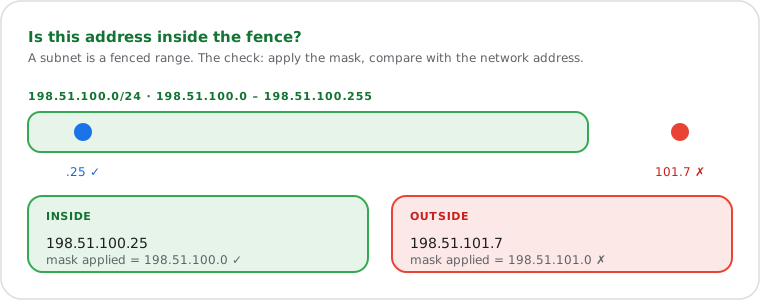
For a /24 IPv4 check: both the target IP and the CIDR network address are right-shifted
by 8 bits (32 − 24 = 8), discarding the host portion. If the resulting 24-bit integers
are equal, the IP is inside the block. For 192.0.2.5 against 192.0.2.0/24:
192.0.2.5 >> 8 = 12648450 and 192.0.2.0 >> 8 = 12648450 — MATCH.
For IPv6, the comparison uses JavaScript BigInt to handle the full 128-bit address space
without overflow. The tool accepts :: compressed notation and expands the elided groups
before computing the shift. All processing runs in the browser — no data leaves the device.
Firewall and ACL validation. Before committing a CIDR-based allow or deny rule to a production firewall, confirm that specific known IPs produce the expected result. A /30 misconfigured as /29 doubles the allowed range — validating against representative addresses before deployment catches this without a live incident.
Cloud security group debugging. AWS, GCP, and Azure security groups express permitted source ranges in CIDR notation. When a client IP that should be permitted is being blocked, confirming whether that IP actually falls inside the configured CIDR range isolates whether the issue is the CIDR definition or another policy.
Log analysis and IP attribution. A sysadmin reviewing access logs needs to determine whether a source IP belongs to an internal corporate range, a cloud provider subnet, or an external network. Checking the IP against known CIDR blocks for each segment identifies the traffic origin without a full WHOIS lookup.