You don't have javascript enabled. Please enable javascript to use this website.

IP to ASN Lookup

Find the Autonomous System Number (ASN) and registered network operator for any IPv4 or IPv6 address.
More Tools

IP to ASN Lookup — Map Any IP Address to Its Autonomous System

IP to ASN lookup maps any IPv4 or IPv6 address to its Autonomous System Number (ASN) and the network operator registered to that address block. An Autonomous System (AS), defined in RFC 1930, is a collection of IP prefixes managed by a single organization under a unified routing policy. ASNs — 16-bit (0–65,535) or extended to 32-bit (0–4,294,967,295) per RFC 6793 — are assigned by IANA and delegated through the five Regional Internet Registries: ARIN, RIPE NCC, APNIC, LACNIC, and AFRINIC. Every public IP address belongs to exactly one AS, identified by the ASN that originates the containing prefix in the global BGP routing table.

PropertyDetail
16-bit ASN range0–65,535 (original allocation, RFC 1930)
32-bit ASN range0–4,294,967,295 (extended 2007, RFC 6793)
Private ASNs (16-bit)64,512–65,534 (RFC 6996)
Private ASNs (32-bit)4,200,000,000–4,294,967,294 (RFC 6996)
Active ASNs globally~85,000 (2026)
Data sourceMaxMind GeoLite2-ASN database, updated monthly

How to Use the IP to ASN Lookup Tool

Identify the Autonomous System Number and network operator for any public IP address in seconds.

1

Enter an IP Address

Enter any public IPv4 or IPv6 address. Private range addresses (10.x.x.x, 172.16–31.x.x, 192.168.x.x per RFC 1918) do not appear in global BGP routing tables and will not return an ASN.
2

Submit the Lookup

Click "Lookup ASN" to query the MaxMind GeoLite2-ASN database for the network block that contains the submitted IP address.
3

Read the ASN and Operator

The result shows the ASN in standard AS##### format and the registered network operator name. Use the ASN WHOIS Lookup link in the result to view the full registration record for the autonomous system.

What the IP to ASN Result Means

FieldMeaningExample
ASN The Autonomous System Number in standard AS##### format. Identifies which AS announces the IP prefix containing the queried address in global BGP routing tables. The same ASN applies to all IPs within the prefix (e.g. all of 8.8.8.0/24 maps to AS15169). AS15169
Organization The name registered by the network operator for this autonomous system at the Regional Internet Registry. Reflects the AS operator, not the end customer or hosted tenant. Cloud provider ASNs (AWS, Azure, GCP) will show the provider name regardless of which customer hosts the workload. GOOGLE

To view the full registration record for the AS — including all announced prefixes, organization handle, and abuse contact — run an ASN WHOIS Lookup with the returned AS number. To view the IP block registration and network range for the address itself, run an IP WHOIS Lookup.

How IP to ASN Lookup Works

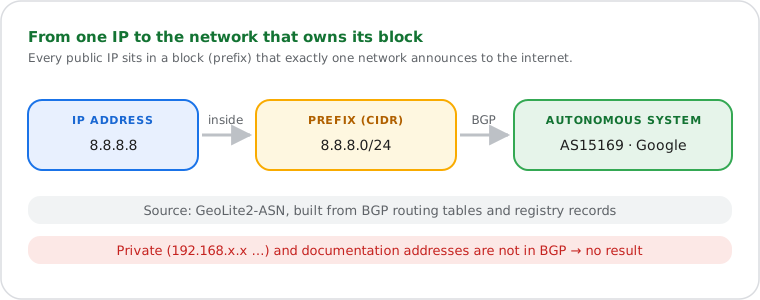
Every public IP address belongs to an IP prefix — a CIDR block such as 8.8.8.0/24 — that is announced into the global BGP routing table by exactly one Autonomous System. IP to ASN lookup resolves this relationship by querying the MaxMind GeoLite2-ASN database, which is built from BGP routing table snapshots and Regional Internet Registry delegation records. The database maps each IP prefix to the ASN that originates it in BGP and the registered organization name for that AS.

Diagram: the IP 8.8.8.8 is inside the prefix 8.8.8.0/24, announced in BGP by AS15169, Google; private and documentation addresses return no result
One IP, one prefix, one announcing network.

Coverage includes all globally routed IPv4 and IPv6 address space. Private IPv4 addresses defined in RFC 1918 (10.0.0.0/8, 172.16.0.0/12, 192.168.0.0/16) and documentation prefixes defined in RFC 5737 (192.0.2.0/24, 198.51.100.0/24, 203.0.113.0/24) do not appear in BGP routing tables and return no result. The GeoLite2-ASN database is updated monthly; for real-time BGP state, tools such as RIPE NCC's RIS Live provide live route visibility.

Do it yourself

How to Find the ASN of an IP Address Without an Online Tool

The Team Cymru WHOIS service (whois.cymru.com) and its companion DNS service (origin.asn.cymru.com) provide structured ASN-by-IP lookups from the command line. Replace 8.8.8.8 with the target IP in the examples below. For the DNS-based approach, non-palindromic IPs require octets reversed: for 203.0.113.1, query 1.113.0.203.origin.asn.cymru.com.

Windows Command Prompt

nslookup -type=TXT 8.8.8.8.origin.asn.cymru.com

Windows PowerShell

Resolve-DnsName -Name "8.8.8.8.origin.asn.cymru.com" -Type TXT | Select-Object -ExpandProperty Strings

Mac / Linux whois

whois -h whois.cymru.com " -v 8.8.8.8"

Mac / Linux dig

dig 8.8.8.8.origin.asn.cymru.com TXT +short

The Team Cymru response returns the ASN, BGP prefix (CIDR), country code, originating RIR, allocation date, and AS name — more detail than the GeoLite2-ASN database alone. Results may differ from the online tool during active BGP routing changes, as the Cymru service reflects near-real-time routing state.
Common Uses for IP to ASN Lookup

Security incident response. A SOC analyst investigating a brute-force attack traces the source IPs to AS9002, a European transit provider. The ASN identifies the correct RIR abuse contact for the block — a targeted report to RIPE NCC rather than a generic upstream ISP complaint, which reaches the responsible network operator directly.

CDN and routing verification. A DevOps engineer configuring egress firewall rules for a multi-cloud deployment uses IP-to-ASN lookup to confirm that inbound traffic from 104.18.x.x belongs to AS13335 (Cloudflare), verifying that anycast CDN routing is active before a production cutover. The ASN check takes seconds and requires no access to cloud console dashboards.

Traffic pattern analysis. A network researcher aggregating web server access logs classifies request origins by autonomous system to identify concentration risk: a disproportionate share of API traffic from three cloud provider ASNs is a common signal of automated traffic or credential stuffing, distinct from organic user distribution.


Frequently Asked Questions

What is an Autonomous System Number (ASN)?
An Autonomous System Number (ASN) is a globally unique identifier assigned to an Autonomous System (AS) — a collection of IP address prefixes operated by a single network entity under a unified routing policy, as defined in RFC 1930. ISPs, cloud providers, universities, and large enterprises each hold one or more ASNs. ASNs were originally 16-bit (0–65,535) and extended to 32-bit (0–4,294,967,295) in 2007 per RFC 6793. IANA assigns ASNs to the five Regional Internet Registries (ARIN, RIPE NCC, APNIC, LACNIC, AFRINIC), which delegate them to network operators. Private ASN ranges (64,512–65,534 for 16-bit; 4,200,000,000–4,294,967,294 for 32-bit) are reserved for internal use per RFC 6996.
Why does my IP address show an unexpected organization name?
The organization name returned reflects what the AS operator has registered with their Regional Internet Registry — not the end customer or hosted tenant. Cloud provider IPs (AWS, Azure, GCP, Cloudflare) always show the provider's registered AS name regardless of which customer hosts the workload. Corporate IPs using a third-party ISP's address space will show the ISP name, not the company name. If the result is completely unexpected, the IP may be part of a recently reallocated prefix not yet reflected in the monthly MaxMind GeoLite2-ASN update. Run an IP WHOIS Lookup to check the current RIR registration directly.
What is the difference between IP to ASN lookup and IP WHOIS lookup?
IP to ASN lookup resolves an IP address to its Autonomous System Number and the operator name — a fast, two-field result used to identify which network manages the address. IP WHOIS lookup returns the full registration record for the IP block: network range in CIDR notation, registration and update dates, country, abuse contact, and RIR handle, sourced via RDAP (RFC 7480) or legacy WHOIS port 43 (RFC 3912). Use IP to ASN for quick operator identification or traffic classification; use IP WHOIS when you need the full registration record, abuse contact, or network allocation details.
How accurate is the ASN data returned?
ASN-to-IP mapping via the MaxMind GeoLite2-ASN database is built from BGP routing table data and RIR allocation records, updated monthly. Accuracy for correctly identifying the originating AS for any globally routed prefix is effectively 100%, since the mapping directly reflects BGP routing table entries. The organization name field reflects the name the AS operator has registered with their RIR, which may differ from the operator's public brand name. IPs announced under multiple origin ASNs (MOAS routes) are resolved to the primary announced origin.
Do you store or log the IP addresses I look up?
IP addresses submitted to this tool are not stored or logged. Each lookup is processed in real time against the local MaxMind database and the input is discarded after the result is returned. No query history or personal data is retained between requests.

Related Guides

Guide What Is an IP Address?
how IPv4 and IPv6 addresses are structured, allocated by IANA through Regional Internet Registries, and used to identify devices on the internet.
Guide What Is IPv4?
the 32-bit addressing scheme, its exhaustion timeline, and how IP blocks are delegated from IANA through Regional Internet Registries to the network operators who hold ASNs.